
According to a recent overview, about 76% of companies now use some form of marketing automation. What’s interesting to me about this adoption is how few of these organizations are specifically disclosing whether they have deployed — or plan to deploy — a drip and/or a nurture campaign. When polling our clients and potential clients, most don’t differentiate between these two campaign styles — and I find that incongruent with the overall benefit they wish to attain using automation.

You should read this guide if you:
- Would like to learn more about email marketing and internet marketing.
- Have a contact list and want to send regular email messages.
- Have heard of email automation but don’t understand how it can work for you.
- Have a subscription to marketing-automation software and need to gain a consistent return on your investment.
- Are confused about the difference between blast email, drip email, and nurture email.
- Need outside help in developing and deploying an email strategy.
Introduction
By most accounts, marketing automation is the greatest thing since…well, since email marketing. The ability to qualify leads and build demand in a fully automated workflow frees us from the high-pressure requirements of constant writing, email development, and journey deployment. It also enables us to personalize and send messages that are both timely and relevant.
In this guide, we define the differences between email blasts, drip emails, and nurture emails — and float some ideas about how you can use your automated-marketing solution to put email marketing to work instead of you working to email market.
Speak the language
Marketing has been around for a long time. Many pundits attribute the 1960s to giving rise to a more formalized academic discipline, but the 1950s are most commonly cited as the era of modern marketing thinking. With more about seven decades to propagate, it’s no wonder common terms aren’t so common any longer and mean different things to different marketers. So, for the sake of this document, here is a translation guide.
Email marketing
Email marketing is the process of sending a commercial message to:
- Prospects — everyone in the world (who are potentially interested in what you have to offer)
- Subscribers — people who’ve shown an interest, but generally just want to have you drop something in their inbox for a while
- Leads — people who’ve declared an interest in what you have to say by completing an action (i.e., filling out a form, clcking a paid ad)
- Customers — people who are using your product (you might have segments for people in a free version vs. those who paid)
Commercial marketing emails fall into one of three categories: blast, drip, or nurture. Each has a different purpose and can be used independently or together.
- Blast email. A single email used to announce news, promotions, or timely offers to a broad audience. Also called single-event, mass, or bulk email.
- Drip email. A series of messages (typically on a scheduled, predefined cadence) to educate, brand, or position your product with subscribers (and potentially customers); typically ongoing, broad messaging.
- Nurture email. A series of messages sent to specific recipients based on previous actions and their position in the buying cycle. Marketing works with sales to map the funnel and deliver the right information at the right time. Also called behavior-triggered or just-in-time messaging.
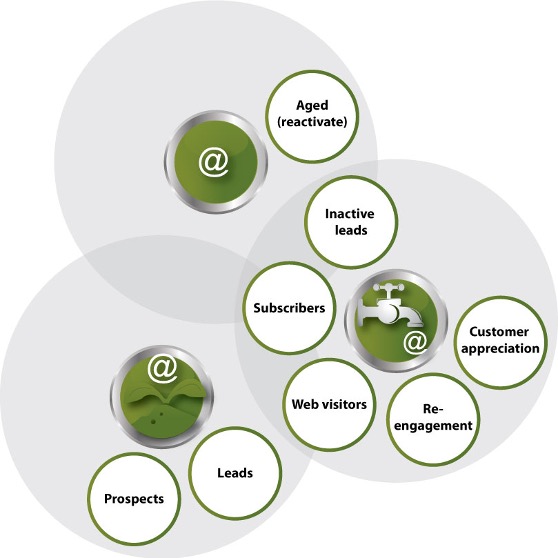
Blast, drip, and nurture have different purposes, but they’re not exclusive. You might announce a special event as a one-off blast and also include it in your drip stream.
Stage
Broadly,prospects, suscribers, and leads follow a funnel process that looks something like this:
- Awareness
- Interest
- Consideration
- Intent
- Evaluation
- Purchase
- Evaluation
- Intent
- Consideration
- Interest
Regardless of stage, type, or content, focus on the customer. They don’t care about your super-great company, unparalleled staff, or cutting-edge tech; they care about themselves. Talk benefits, not features — and then choose to blast, drip, or nurture.
Content type
Whether you blast, drip, or nurture, four content types help elicit different responses and surface the recipient’s stage:
- Viral/emotional. Appeal to emotions and show you understand goals and pain points.
- Discussion. Invite comments, surveys, and feedback. Start small; grow asks as commitment increases.
- Lead. Offer high-value content (i.e., white papers, training videos, trials, eBooks). Gated content helps you learn interest area and intensity.
- Sales. Ask for the business and provide a clear path to purchase.
Prospect type
Triggered marketing enables discovery, and with that, relevant answers in real time. Prospect types:
- Most aware. Knows your product; needs the offer.
- Product aware. Knows what you sell; unsure it fits their needs.
- Solution aware. Knows the result needed; unsure your product addresses it.
- Problem aware. Feels the problem; unaware a solution exists.
- Completely unaware. No knowledge of product/solutions but opinions abound.
Get started
Profiling
The most successful campaigns are relevant: focused on the recipient’s needs, pain points, desires, and funnel stage. If you don’t know this about your list, good — your early campaign activity is as useful for discovery as it is for maintenance, nurturing, and sales.
As messaging events launch and you begin to collect information, segment early responders into buckets; others will join as their profiles become partially or more complete. Early on, learn who your prospects are and where they are in the funnel. Use links and content that surface interests when clicked. Creativity here pays off.
Blast messaging
Blast messaging — often a short-term promotion or an announcement — is sent en masse to your list. Though categorized as single-event, there are typically multiple components: the launch email, auto-responses, forms, and landing pages. That makes it a campaign — not just an email, SMS, or social post.
Blasts and triggered emails can be promoted across multiple channels simultaneously. Whether you call it multi-touch, multi-channel, or cross-channel, the point is to combine vehicles to make the message memorable and extend reach.
Best-practice reminder: a nurture email usually focuses on a single action (e.g., complete a form for a white paper). Limit distractions. With a blast, you have more design flexibility — multiple links and topics can be intentional to expose interests, drop contacts into the right buckets, and fire a relevant drip or nurture sequence.

In this blast example, multiple links (logo, menu, social, contact) let you observe what each recipient finds interesting.
Triggered messaging
Defining parameters and constructing triggered campaigns is no small undertaking. A triggered program can include dozens or hundreds of activities over months, a year, or more. Over time it requires less effort than a string of blasts, but there is upfront overhead in time and resources. Today’s marketing-automation platforms help offset this with better builders, templates, and analytics.
Drip (scheduled events) and nurture (behavior-based events) aren’t limited to email. When appropriate, integrate print and other channels. Offline tactics can be more expensive and harder to track — but not impossible.
Automation lets you show up with the right offer at the right time — relevant to them, not just convenient for you. With segmentation (explicit data) and behavior (implicit data), you can materially improve:
- Response rates
- Cross-sell and up-sell activity
- Relevance of messages and offers
- Timeliness of delivery
Drip messaging
Drip marketing is a series of predesigned emails sent on a predetermined schedule to educate, brand, position, or sell. Drip emails are broad; nurture emails are segment-specific. Sometimes the answer is both.
Three common drip triggers:
- Anchor date. Events before/after a specific date (e.g., product launch).
- Calendar. Scheduled dates (e.g., holidays).
- Duration. Time since subscription/entry.
You likely have drip emails in your inbox right now: a weekly “what’s new” from a brand you follow. All subscribers get the same message with light or no gating.

In a simple drip, a new subscriber receives a weekly in-store events email (B2C) or a weekly industry-news brief (B2B).
Many companies (even automation vendors) use drip and nurture interchangeably, but the approaches differ. Drip includes the content in the email (news item, announcement, offer code). It may include many links — site, social, contact. Clicks reveal interest and can move a name into a new bucket for more aligned content. We call drip passive engagement and nurture active engagement.
In other words, a click from drip suggests advancing interest and sales readiness. That’s the signal to start nurturing with higher-value (often gated) content.
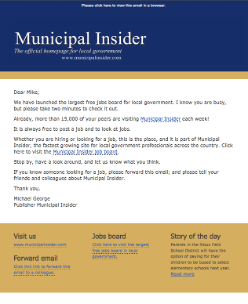

Subscribe to the Municipal Insider list and you’ll receive a monthly email with reminders, offers, promotions, and other municipal-focused information.
As a rule, drip messages don’t push gated assets — that’s nurture’s job. You can use gated content in a blast to attract new subscribers who then enter drip or nurture.
Design consistently across a drip series. Keep structure recognizable (preheader, header/logo, body, footer). Familiarity reduces “who are you again?” deletes.
Best practice: aim for ~80% content / 20% pitch. Start with three or four purely helpful sends, then weave in conversion paths.
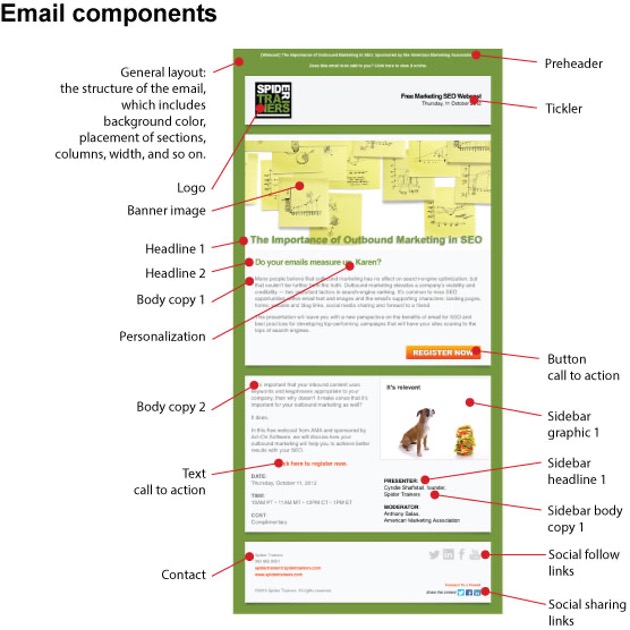 Drip email templates benefit from consistency; swap hero and copy each month, keep structure and styles stable.
Social posts can function as drip too. Same cadence mindset, same goal. When a follower subscribes, they’ve declared deeper interest — drop them into an email drip, and as they engage, advance to nurture.
Nurture messaging
Nurturing emails are sent to specific contacts based on actions and funnel stage. Because they’re triggered by behavior (purchase, form submit, pricing-page view, etc.), they’re often called transactional or behavior-based emails. These consistently outperform general drip-style messaging and provide the perfect canvas to introduce next steps, answer likely questions, and cross-sell or up-sell when appropriate.
Common trigger types:
- Transactional triggers. Purchase, form submit, content download — often with an immediate confirmation/thank you. Use the follow-up to reduce buyer’s remorse and extend engagement with helpful links.
- Recurring triggers. Birthdays, anniversaries, last visit — classic loyalty plays.
- Threshold triggers. Milestones reached — miles flown, dollars spent, points earned.
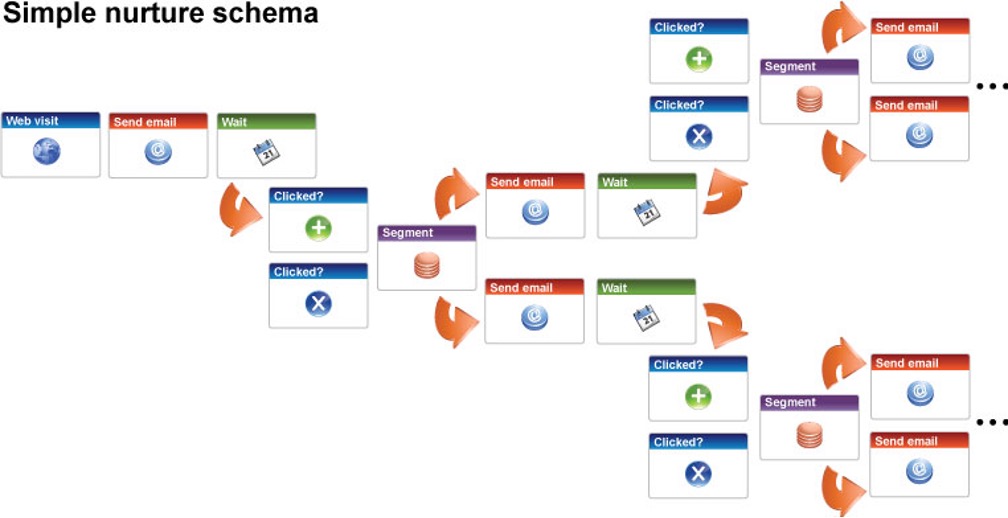 A nurture flow might start with “downloaded price list,” then branch on engagement and send the next message accordingly.
Design nurture messaging to follow a logical progression through the purchase funnel. It’s easier for sales to close when a prospect has been steadily educated — and when you can show the trail through analytics and lead scoring. Decide whether to end the nurture upon handoff to sales or to move them into a post-purchase drip to reassure and onboard.
Success hinges on segmentation and tracking. When someone engages, move them to a bucket with others who behaved similarly; advance their knowledge in the topic they signaled. Augment behavior (implicit) with demographics and firmographics (explicit) gathered over time via progressive profiling.
- Firmographics describe an organization (what demographics are to people): employee count, revenue, industry, locations, HQ, etc.
- Progressive profiling displays conditional form fields based on known data to keep forms short while learning more over time.
- Explicit data includes demographics and stated info.
- Implicit data includes actions: opens, clicks, downloads, video views, site visits, shares.
(And yes, engagement naturally drops over a subscriber’s lifetime — another reason to keep content relevant and let automation carry the load.)
Schema (workflow)
Drip and nurture programs are complex, but a methodical approach helps. Your platform likely has a robust visual builder, but for campaigns spanning a year or more, start rough: sketch the flow, run it past sales, and refine.
If you’re building an annual program, start with a monthly schema. With that in hand, drill down to a weekly schema, and if necessary, a daily view.
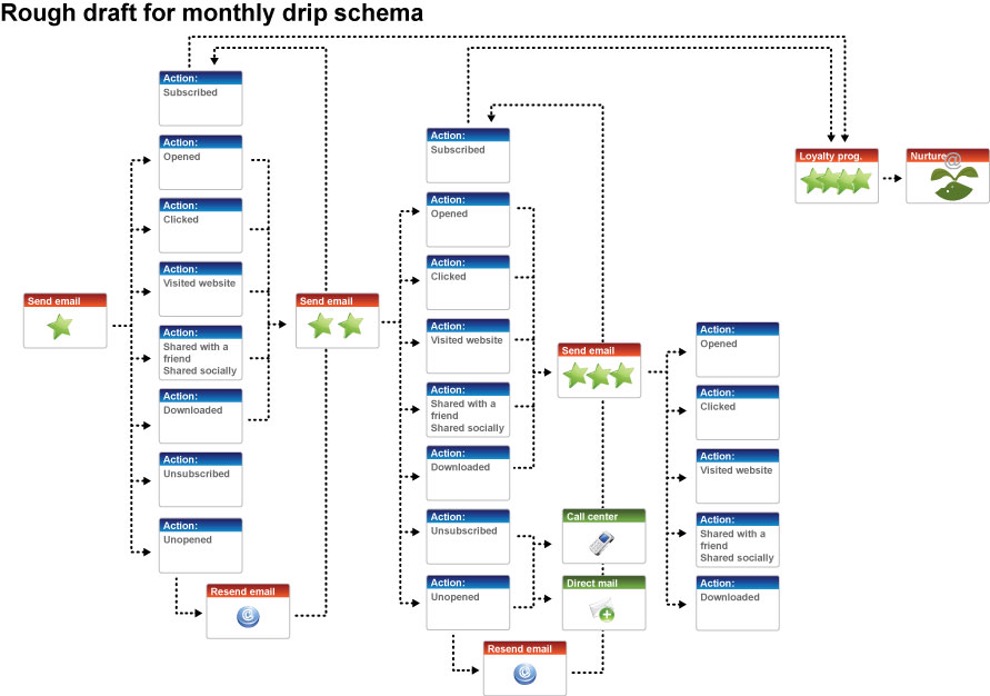
Any diagramming app (such as LucidChart or Figma) works for drafting a flow. Sales is your best partner for mapping the path from prospect → subscriber → lead → customer (or your equivalent). Launch offer, timed reminders, last-chance, then — on purchase — move to a drip that reinforces a wise choice (i.e., testimonials, case studies, onboarding).
Optimization opportunities
Most companies need blast, drip, and nurture — one isn’t enough — but the team is already tapped. Your marketing operations team can use these blockers as indicators you need a techstack audit to identify AI automation opportunities.
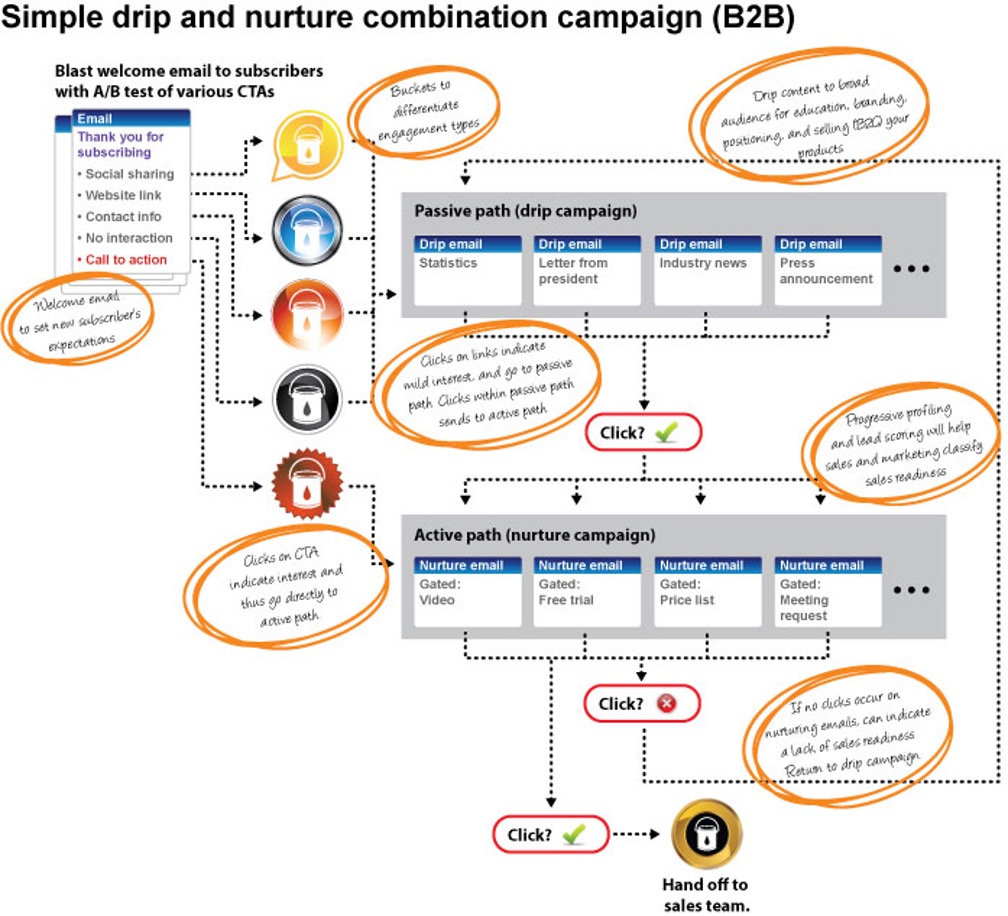
For most companies, email messaging is a mix of the three campaign styles. Blasts are used for on-the-spot promotions or to test an acquired list and drip and nurture are used to stay top of mind and nudge recipients along the sales funnel.
The illustration above is a very brief example of a combined drip and nurture campaign, there are four or more launch emails in order to A/B test the call to action. This could be the same offer stated in four different styles, four subject lines, four buttons styles, four headlines, or any single item you wish to test.
After the launch email, names are dropped into buckets based upon the links clicked, thereby disclosing their interest type: social engagement, product information at the website, contacting a salesperson, or opened but no interaction. All four buckets will be dropped into the passive or drip campaign first and as links are clicked, shuttled to a nurture campaign. If after the nurture campaign has been exhausted, and no links have been clicked, the name is recycled into the drip campaign.
If you’re ready to give your marketing-automation software a steady job, call MKTGWEBOPS. We will architect an automated-marketing program that will ensure you get the most from your human, software, and hardware resources.
Editor’s note: I wrote this article some time ago — but the principle hasn’t changed. This lightly updated version reflects current tools and practices while keeping the same lessons intact.
AI disclosure: This content was originally written by me and later updated with assistance from OpenAI’s GPT-5 for light editing, fact-checking, and modernization. Every word has been reviewed and approved by a human — specifically, me — before publication.
For most companies, it’s not a question of drip OR nurture; it’s drip AND nurture.