Framework first, polish later
When we started MKTGWEBOPS, we launched our site with a strategic decision that goes against conventional wisdom — we prioritized getting our framework live over perfecting speed, SEO, or user experience that would delay launch. With two web experts and a content expert on our team, we knew optimization would come naturally once we had enough substance to work with.
Weeks later, when we saw our first website performance report, the results showed ample opportunity for optimization.
This is how we took that website performance rating from a D to an A in one day.
[Establish] a solid five-page framework that could grow as we refined our company focus and messaging.
The website
Starting with structure: The five-page foundation
Our initial approach focused on establishing a solid five-page framework that could grow as we refined our company focus and messaging. This skeletal structure gave us the flexibility to be nimble and test different ways to articulate our value proposition while building out content that is relevant and resonates with our target clients.
The AI-driven content strategy: Ten questions, ten pages
We consulted Claude, Perplexity, and ChatGPT to surface the top ten questions our audience asked about marketing operations and optimization, then built focus pages around each question as the page title. While we’re still monitoring whether these AEO-focused pages move the needle on traffic and engagement, they represent our experimental approach to Answer Engine Optimization in an environment where best practices are evolving.
The AEO reality: Still the wild west
After attending webcasts, listening to podcasts, reading countless blogs, and consulting directly with AI systems, we’ve learned that answer engine optimization best practices remain highly subjective — everyone claims to have the key, but verifiable approaches are elusive. We are currently testing three AEO approaches on the site: question-based focus pages, new optimization service pages, and free resources, which represent our commitment to testing hypotheses rather than waiting for definitive answers that may never come.
Finding our core: Optimization as the throughline
Working with a CRO client helped us crystalize our positioning — optimization isn’t just about website funnels; it’s how we approach our entire service offering. We reorganized our site around our seven focus areas (What we do):
- operations and workflow
- martech stack and vendor management
- content and brand
- customer sentiment
- customer journeys and automation
- web and digital (including ad platforms)
- CRO
This optimization lens helps clients understand why we believe content, customer journeys, and customer sentiment are critical contributors to the marketing operations organization. The content team crafts our A/B, split, and multivariate testing versions on web pages and in customer journeys. The customer sentiment team gathers feedback, and the workflow team builds feedback loops.
Dual lens approach: Operations and optimizations pages
We expanded the What we do menu to include both operations pages and optimization pages for our focus areas. Operations pages describe our services through the traditional marketing operations lens, while optimization pages drill down to our differentiated view emphasizing optimization, automation, and AI. This dual structure lets prospects enter through whichever mental model brought them to our site while we guide them toward understanding how optimization transforms traditional marketing operations.
The optimization expansion: Making our approach tangible
Adding the new optimization pages to the site — each following a consistent format that maps the specific blocks we optimize — helps clients understand and appreciate what optimization looks like in practice (with before/after comparisons), and how the focus areas connect.
These pages serve double duty: while they are primarily for visitor education, they are also structured to support AEO, and we are monitoring answer engines closely for reference to these topics.
[For us] optimization isn’t just about website funnels; it’s how we approach our entire service offering
This rapid iteration cycle — observe, analyze, implement — exemplifies the advantage of having dedicated web expertise on staff rather than queuing for available for external resources.
The techstack
The optimization awakening: From D to A in a day
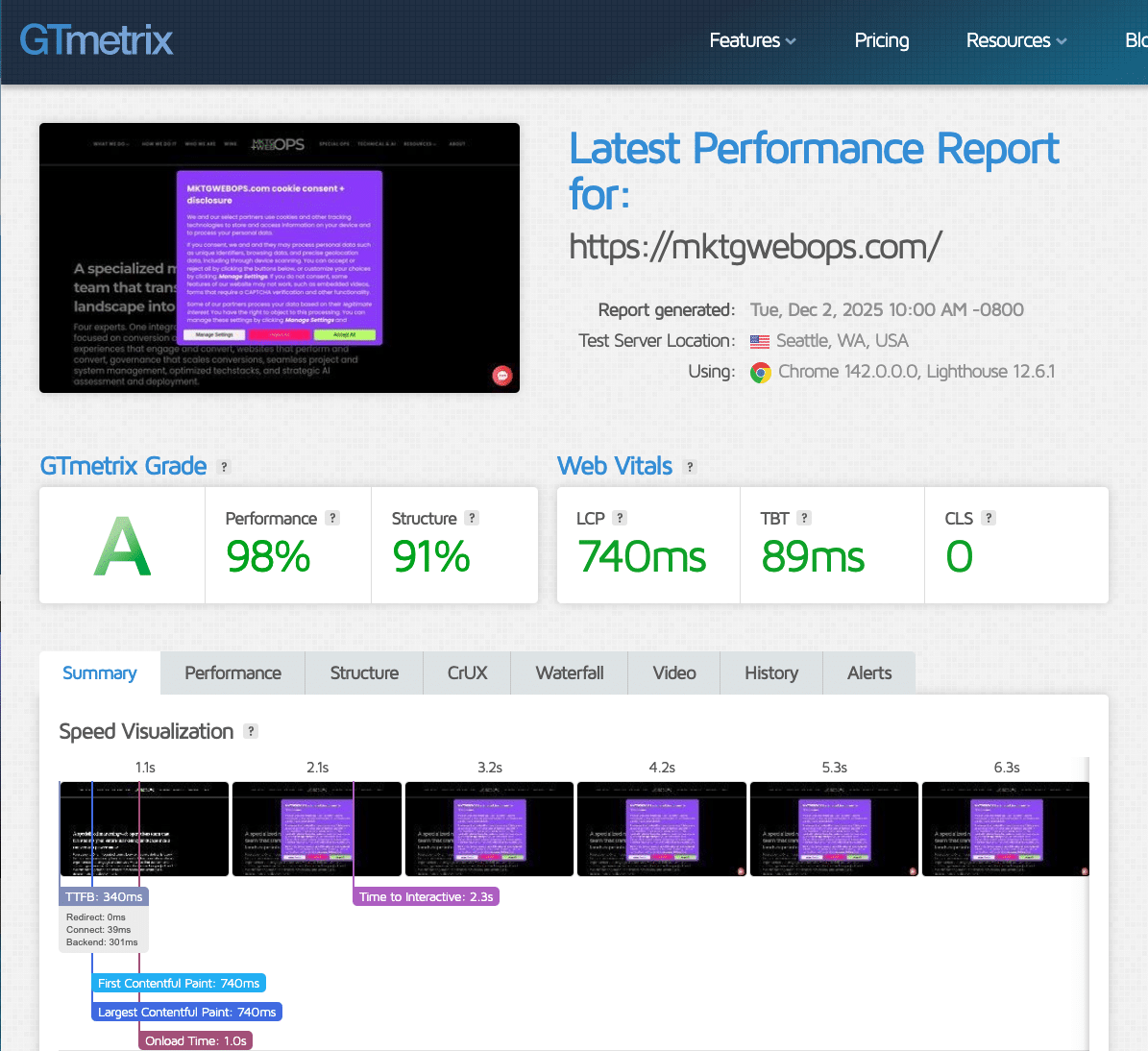
When we added MKTGWEBOPS.com to our GTMetrix account to benchmark and monitor site performance, the initial D rating was a wake-up call — though not entirely surprising given our framework-first approach. After we configured GTMetrix, we immediately prioritized optimizations to improve performance—just as we would for a client’s site. We installed and configured WP Rocket (a WordPress plugin designed to deliver speed and enhance performance) and Imagify (a WordPress plugin for optimizing existing and uploaded images), which bumped our D rating to a B.
GTMetrix also reported that the video on our homepage was the most egregious culprit (followed closely by our handy little chatbot), so disabling it pushed us to an A rating. We’re in no hurry to give up that performance, even though we know we can’t leave the homepage as-is indefinitely.
Assembling our optimization toolbox
We assembled our core optimization toolkit methodically: Google Analytics for site metrics, GTMetrix for performance monitoring, Microsoft Clarity for behavioral insights, Cloudflare for security services, WP Rocket for caching, and Imagify for image optimization. Each tool addresses specific performance bottlenecks while maintaining our ability to move quickly.
Real-time optimization: Clarity-driven changes
Installing Microsoft Clarity allowed us to watch actual customer interactions with our site. We immediately saw the homepage video was a problem, as GTMetrix later confirmed this, so we made structural changes based on those visitor-experience recordings. This rapid iteration cycle — observe, analyze, implement — exemplifies the advantage of having dedicated web expertise on staff rather than queuing for available for external resources.
The video dilemma: Performance versus visual impact
Our biggest performance bottleneck, the homepage video, was complicated by theme limitations that only support self-hosted or YouTube videos for background placement. We’re now testing an animated GIF approach as a compromise — maintaining visual interest without the performance hit, though this means temporarily sacrificing the polished look we’d originally envisioned while we work out the right balance.
The environment
DNS migration: The GoDaddy gauntlet
Migrating DNS management from GoDaddy to Cloudflare meant navigating friction in GoDaddy’s process: calling support, enduring hold times, and convincing them to release DNSSEC so we could create our DS record. The technical steps weren’t complex, but the barriers highlighted how hosting providers can make infrastructure decisions unnecessarily painful — especially if you do not have a web administrator on your team.
The VPS strategy: Automation as infrastructure
Alongside our website, we also deployed a dual-purpose VPS to initially support n8n automations for internal efficiency. And soon it will serve as a foundation for free marketing tools we’ll offer clients from our resource pages, which are also AEO tests. We know how important resources are to SEO, but we want to see if we can attract people to the site from a search process that is less and less about the website visit.
The VPS infrastructure investment reflects our core belief that AI and automation should underpin modern marketing operations, not just supplement them.
Security and privacy: Cloudflare as our compliance layer
Given our backgrounds working in FCC-regulated environments and our extensive work on GDPR, CCPA, and privacy advocacy, we need security features that meet our own exacting standards. Cloudflare’s security suite includes real-time vulnerability alerts, which gives us the control and visibility we require, especially important since we work with clients in privacy-sensitive and compliance-heavy sectors.
The paid plugin principle: Quality over free
We never install freebie WordPress plugins. We always purchase the appropriate subscription level, based on our belief that funded developers are more likely to make investments in privacy, security, and compatibility. While we’re not held to the same standards as an enterprise with SOC2 requirements, we have those standards in mind when deciding what we install; Cloudflare’s alerting system ensures we’ll know quickly if a plugin enables a vulnerability.
Tool conflicts and strategic trade-offs
The conflict between CAPTCHA Enterprise 3 (integrated with Gravity Forms) and our Defender security plugin forced us to make exactly the kind of decision we help clients navigate: which tool provides the best overall solution when multiple options overlap? In our case, since we had already invested in Cloudflare’s other security options, it made sense to switch out Google’s CAPTCHA product for Cloudflare’s Turstile offering to further strengthen our security posture.
The hosting balancing act: Shared servers vs. premium environments
Our $700/year GoDaddy shared hosting supports unlimited sites, which is where our legacy client websites are hosted. As much as we prefer WPEngine’s three-stage environment, the $50/mo fee for a single site is hard to justify for a site with fewer than 50 pages.
This trade-off reflects the practical economics of running a lean operation while maintaining professional standards. We’ve experienced the downside, though: we spent two days intermittently locked out while configuring security in a way that allowed our remote work from various work sites. This delayed our Cloudflare CDN deployment, but it’s impending.
Though our small organization may not warrant the effort, the services we provide clients do. We have already begun standing up Github and Git so that we webdevs are not working on live sites with digital backups as a rollback plan. Github will allow us to work in parallel without having to maintain three separate environments, and create a collaborative review and publish process even Jess, our content director will appreciate.
Measurement and monitoring: Performance first
With the site now fully developed — though a living, breathing document we update daily — we track site health through several complementary systems:
- WPMUDEV’s SmartCrawl keeps a continual eye on SEO (reporting a 92/100 SEO score).
- Google Analytics 4 monitors engagement patterns.
- Clarity reveals user behavior.
- GTMetrix measures technical performance.
This multi-tool approach gives us comprehensive visibility into different aspects of site performance and user experience.
With the site now fully developed — though a living, breathing document we update daily — we track site health through several complementary systems.
Our own site build-out mirrors the process we guide clients through: start with a strategic framework, add substance, then optimize based on real data rather than assumptions.
Building toward the typical marketing techstack
The typical marketing techstack includes 50+ tools, and we’re well on our way to that number ourselves. This hands-on experience directly informs one of our core services: marketing techstack audits using our proprietary database of marketing app features, allowing us to quickly identify what clients already have on hand to solve problems, what AI features developers might have added since they purchased those tools, and how we can save them money by deprecating duplicative tools.
As much as all-in-one tools seem like a good idea, I have achieved better results choosing a small suite of tools and connecting the data through Zapier, Boomi, and other data-piping processes. Though this process is generally my preference, our focus on optimization begins with the marketing techstack audit. We approach this as, “Let’s see what you have and how we can get the most from the tools you’ve already onboarded before we consider deprecating or migrating.”
Conclusion: Practicing what we preach
Our own site build-out mirrors the process we guide clients through: start with a strategic framework, add substance, then optimize based on real data rather than assumptions. The journey from D to A scores in GTMetrix in less than a day demonstrates what’s possible when you assess your martech stack honestly, make strategic trade-offs, and aren’t afraid to test approaches in areas where best practices haven’t yet crystallized.
As we continue publishing our optimization pages and monitoring how they perform against our operations pages, we’re doing exactly what we ask clients to do: test, measure, refine, and let the data guide the next iteration.
 Yes, we use AI tools to streamline operations, optimize content, and provide a consistent experience. We believe AI is critical in today’s workflow. AI enables us to automate rote or complex tasks so our team can focus on delivering content and services that only come with decades of experience.
On this page, AI helped by organizing my random, scattered notes into a cohesive story. Though I let ChatGPT take a first stab at it, I wasn’t happy with how it was organized—it wasn’t representative of our actual workflow.
Even when we use AI, our team reviews and approves every AI-assisted element before publishing to make sure it’s accurate and true to our brand. And, sometimes, it’s a total rewrite.