Marketing leaders are sweating bullets right now. You invested in AI tools, built the dashboards, launched campaigns, and reallocated budget to make it all happen. And as the numbers roll in, you’re hard-pressed to prove your AI investment is paying off.
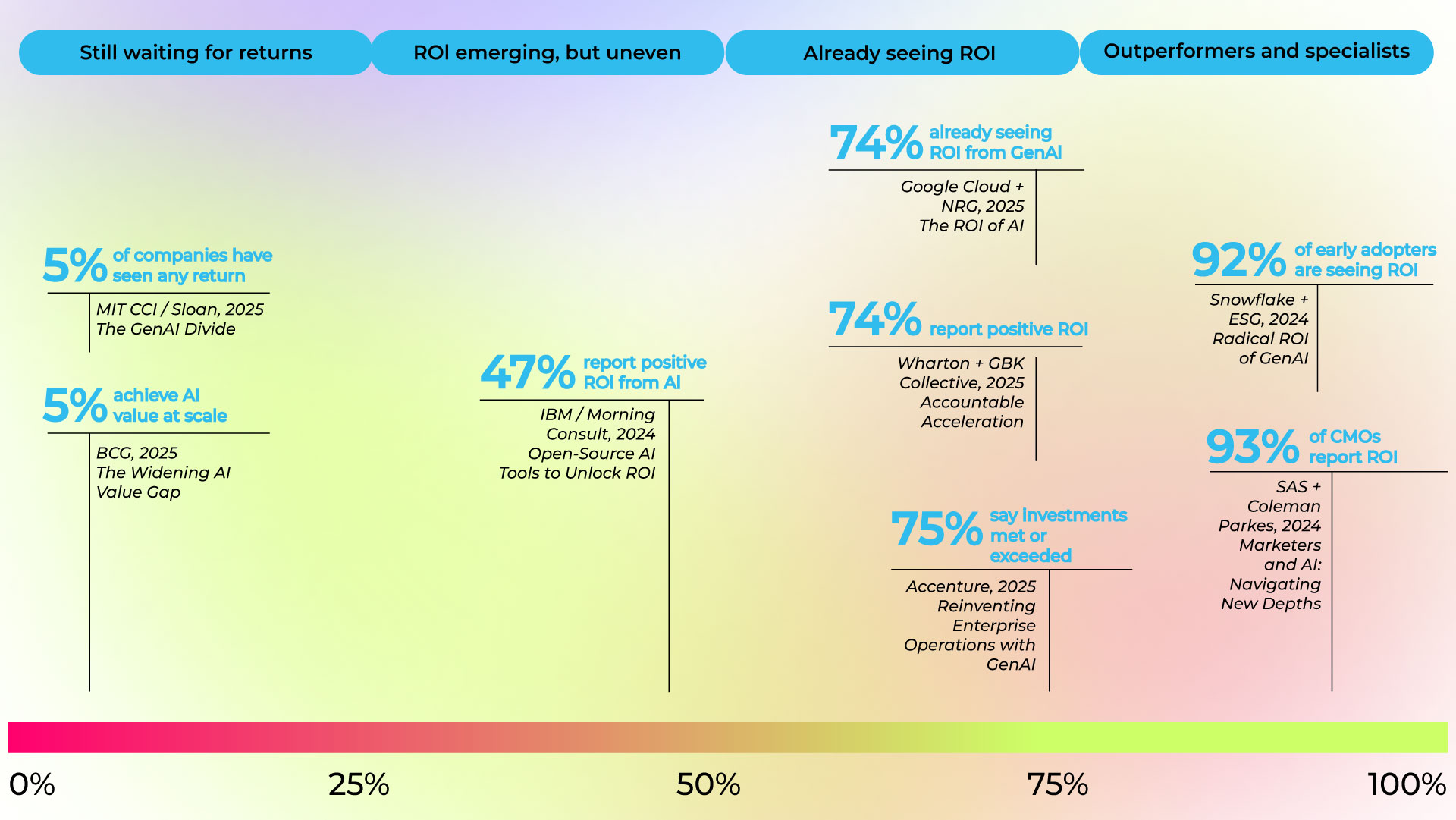
The divide between rising AI-driven martech spending and unclear, inconsistent returns is pervasive. Executives feel it. Marketing leaders live it. And until you see the full picture, you’ll keep asking the same questions: Are we getting enough ROI from AI marketing? What do other companies actually get? How can we measure it reliably?
We’re going to break down the big mysteries around AI marketing ROI:
- Why AI marketing ROI numbers vary so widely
- Where hidden costs erode value
- Why many teams aren’t using the AI they already have
- What leaders should measure to close the AI ROI gap
- How to use an audit of your martech AI stack
Why AI marketing ROI varies so widely across studies and teams
If you’ve tried to make sense of research on AI marketing ROI, you’ve probably noticed something strange: every study seems to tell a different story.
It’s possible the seemingly conflicting numbers on the ROI of AI in marketing are all right because most aren’t measuring the same things.
The CMO Survey, for example, highlighted that marketing leaders who use AI report around 5 – 7% gains in sales productivity, customer satisfaction, and reduced marketing overhead.1 That suggests modest but seemingly consistent value from adding AI to marketing workflows.
McKinsey’s global survey tells the story from a different slant: in evaluating AI’s impact on company’s financials, only 39% of leaders say AI has delivered any measurable EBIT improvement.2
Two factors are fueling the wildly different reports about the ROI of AI in marketing.
- They’re not measuring the same kind of ROI.
- The CMO Survey measured perceived improvements in team-level KPIs like productivity and customer satisfaction. It’s asking “Is AI helping your marketing team work better?”
- McKinsey measured observable impact on enterprise-level financial performance. Leaders here are answering, “Is AI moving the company’s financial needle?”
Those are different questions, so of course the numbers don’t match. If your own numbers vary, you may not be doing it wrong, but might be making an apples-to-oranges comparison.
- Most companies are still early in the adoption curve.
- The CMO Survey noted that marketers are using generative AI for only a small fraction of marketing activities.1 That’s not the same as how many marketers are using AI at all; while the surveys find nearly 9 out of 10 marketers are using AI, usage rarely spans their full workflow.3
-
Most importantly, only 21% of companies using generative AI say they’ve redesigned workflows, which McKinsey identifies as the strongest driver of real financial impact.2
The combination of early-stage adoption, varying definitions of ROI, and self-reported performance data starts to explain why executives’ heads are spinning.
The mixed stats don’t cancel each other out, though; even organizations reporting increased productivity since adopting AI tools are mostly seeing those improvements at the individual level — not at scale. Atlassian’s 2025 AI Collaboration Index found 96% of companies using AI have not yet experienced transformational benefits to deliver long-term ROI.4
AI marketing ROI numbers are inconsistent because we’re comparing mismatched metrics at different stages.
The hidden costs of AI in martech (and why they distort ROI)
ROI is a ratio of value output over cost input. Martech has been a major contributor to the cost side of the equation for years. Even before every platform started adding AI-enabled features, martech spend added up to $131 billion in 2023. But current estimates put martech costs at $215 billion by 2027.5
Pre-AI, your marketing techstack was a bicycle pump. In the age of AI-enabled-everything, it’s an air compressor.
Surveys estimate nearly two thirds of martech budgets now go to AI,6 and 61% of marketers now say overall cost is their top martech challenge.7
But the costs run deeper. The IBM Institute for Business Value found the average cost to compute — including cloud and infrastructure — has soared roughly 90% in the past two years,8 and most executives say generative AI is why.
While leadership isn’t wrong in blaming rising costs on AI, there are several factors contributing to AI expenses:
- Multiple tools offer AI for the same tasks (i.e., lead scoring, content generation, SEO), so many teams pay for the same AI-enabled features across several tools and only use them in one (or worse, not at all).
- Vendors continue to add new AI features faster than marketing teams can adopt them, so platforms get more expensive while usage stays flat.
- Some platforms automatically enable AI-powered features that trigger additional compute, storage, or API use, raising costs even when teams aren’t intentionally using them.
- AI tools often rely on behind-the-scenes cloud processing every time you use them, stealthily increasing infrastructure costs.
This is perhaps the biggest question surrounding AI marketing ROI: are AI-related costs outweighing AI-related gains? If so, how long will it take for the tide to turn favorably?
That will depend on how quickly marketing teams establish AI governance to rein in excessive martech creep and adapt workflows to capitalize on automation opportunities. We deep dive into the importance of strategic AI guidelines to balance the strengths of humans and technology in another article: The Pitfalls of All-or-Nothing Approaches to AI.
Why most teams aren’t using the AI they already pay for
While martech budgets are ballooning so dramatically they could feature in the Macy’s Thanksgiving Day Parade, most teams aren’t even making use of the AI capabilities already embedded in their techstack.
- Their AI modules are licensed, but not activated.
- Marketers don’t know which tools have AI features.
- They continue with manual workflows despite options to automate.
- Their organization lacks centralized tracking for AI adoption and usage.
- Teams receive little to no training on AI tools.
- They buy AI tools without evaluating overlap with existing platforms.
The CMO Survey found that while many teams report modest gains from AI, most aren’t using it for advanced functions such as predictive analytics or media optimization, even if their tools offer those features.1
That’s not necessarily because teams don’t think to use AI for those purposes; in many cases, they can’t: 74% of U.S. teams say they’re not getting the most out of AI because it can’t access the right data.4
This further muddies the water on AI returns because you can’t measure ROI on AI that marketing teams aren’t using (or aren’t using consistently). It ties back to a central, recurring point in the data: most companies are giving teams access to AI, but not restructuring how they work to fully incorporate the technology.
To actually use the AI tools you have instead of just collecting them in an expensive techstack, your team needs to know what tools they have, how to use them, and have an infrastructure that supports leveraging the features you’re paying for.
Want consistent value from AI? Build it into your team’s workflows rather than leaving its use to individual decisions. AI should add convenience, not hurdles.
Want consistent value from AI? Build it into your team’s workflows rather than leaving its use to individual decisions. AI should add convenience, not hurdles.
The marketing leadership dilemma: rising expectations, unclear outputs
Marketing leaders are feeling added pressure on three fronts since the AI surge:
- The C-suite expects clear ROI and efficiency gains.
- The CFO wants justification for rising martech budgets.
- The marketing team needs guidance on which tools to use and how.
You’re trying to meet all these demands immediately, so dashboards are multiplying and you’re overwhelmed with AI vendors stuffing your inbox, promising results. And even after buying the tools and comparing data, a gut-wrenching question lingers: “Are we actually getting ROI from AI, or are we assuming we are?”
Unfortunately, many marketing teams are in the assumption camp because they haven’t yet made foundational adjustments to optimize their processes for AI integration. Updating workflows for AI and setting up KPIs to measure results are key steps both McKinsey and Atlassian outline to see real financial impact.2 4
Leaders can breathe easier about answering tough questions when they do the boring work: setting up an environment for automation to produce measurable ROI — not just buying AI tools and hoping.
Measuring AI marketing ROI (a practical framework)
If there’s an upside to the mismatched numbers on AI ROI so far, it’s that leaders know not to consider only revenue and conversions or only productivity — both matter.
This list can help you view the full picture of the impact of AI on your marketing efforts:
- Tool utilization: is your team using the AI features in your martech stack?
Look at activation rates, usage frequency, and adoption (at the user level and feature level).
If your team doesn’t know the AI features included in your licenses, there’s a good chance they’re not even activated. You can’t measure ROI on features no one’s using, but you’re definitely paying for them.
- Workflow impact: which manual tasks has AI replaced?
Map tasks before and after AI adoption. Compare time per task and end-to-end cycle duration.
It’s not a matter of whether AI is faster — you know it is — but whether your team has stopped doing tasks the manual way. If you’re running AI alongside traditional processes “just to be safe,” you’re doubling work instead of replacing it.
- Performance impact: have your results changed?
If you’re A/B testing, look at AI vs non-AI segments to track and compare KPIs (i.e., conversions, cost per lead, revenue).
- Cost alignment: do your tools offset spending or add to it?
Assess function overlap, redundant licenses, cloud consumption, and AI-related surcharges.
Tools that save you time could be costing you elsewhere. Weigh whether the AI content generator reducing your copywriting hours is worth a potential $2K/month spike in your cloud computing bills.
- Redundancy: do you have multiple tools with the same features?
How many of your tools offer AI-driven lead scoring, content creation and optimization, or automation? Most marketing teams don’t even realize their techstacks have two, three, even four tools that do the same work. For example: if you have HubSpot, Marketo, and Jasper, you’re paying for AI content generation three times.
- Capability alignment: have you adapted your workflows and trained your team for AI?
To cross the bridge from AI contributions that are neat to fundamentally shifting processes for scale and ROI, marketing needs to revise workflows for automation and teach humans to fully take advantage of it. We can’t emphasize it enough: workflow redesign is the top predictor of AI ROI.
These dimensions can provide proof of whether your AI investment is paying off, so you don’t have to face your C-suite with only wishful guessing or vendor promises.
How to audit your marketing AI stack to get real ROI clarity
An audit isn’t exciting, but the outcome is. Auditing your AI utilization is the best way to understand the steps to take to maximize ROI. You end up with a rundown of everything going right — and wrong — with your team’s AI approach:
- An inventory of every AI-enabled tool in your martech stack
- Tool redundancy and cost waste: whether each feature is licensed, activated, used, or duplicated elsewhere
- Gaps in workflow automation
- Data readiness and integration
- Team AI adoption and proficiency
When you see it outlined in one report, you can seize quick wins and lay out your roadmap to implementing opportunities in your existing stack for measurable ROI. Chances are you don’t need to spend more on AI; you can extract value from what you already have by using it better.
You may discover your team has three or four premium generative AI chatbot licenses they’re only using to write and optimize email copy, and that AI feature’s already built into the email platform you use.
When an external AI audit makes sense
It may be worth opting for a third party audit if:
- your martech stack has been growing without strategic oversight.
- your costs are rising faster than outcomes.
- different teams use different tools without a consistent, shared measurement approach.
- your usage data is incomplete or missing.
If your techstack is large or complex and trying to articulate the return on AI investment feels like wading through mud, an independent audit may provide the objectivity and clarity to see your situation with fresh eyes.
Closing the AI ROI divide
All signs point to the potential for substantial ROI from AI in marketing — enhancements that produce consistent, measurable results and free teams up from grunt work to dedicate effort to strategy and creativity.
It’s not as simple as plugging AI into your current marketing ecosystem and voilà.
Teams that effectively integrate AI tools in a way that produces greater returns than costs will:
- choose AI capabilities strategically and eliminate redundancy.
- redesign workflows around automation opportunities.
- train users on the features they have and how to use them.
- monitor and measure usage to track costs vs. gains.
Most organizations aren’t set up this way yet, which is why industry reports on AI marketing ROI are inconsistent and may not align with your own experience.
If you want to apply strategic precision to marketing AI, you know where you need to start: an audit.
MKTGWEBOPS offers AI utilization audits specifically for marketing teams flush with tools and coming up short on solutions. We’ll map the AI features in your martech stack, identify waste and gaps, train your team on how to use your AI tools, and deliver a prioritized roadmap for cost savings and workflow optimization within two weeks.
No charge, no strings — just clarity.
References
- The CMO Survey — “Marketers say artificial intelligence has a positive impact on performance.” Duke University Fuqua School of Business.
- The state of AI: How organizations are rewiring to capture value. McKinsey & Company.
- 28 AI marketing statistics you need to know in 2025. SurveyMonkey.
- The AI Collaboration Index. Atlassian.
- Rewiring martech: From cost center to growth engine. McKinsey & Company.
- Capgemini Research Institute — Generative AI & the Evolving Role of Marketing
- The CEO’s Guide to Generative AI: The cost of compute. IBM Institute for Business Value.
- The Future of the Martech Stack 2025. Ascend2 Research.
You can stop guessing and be back on track to AI ROI before the next quarter’s reports.
 Yes, we use AI tools to streamline operations, optimize content, and provide a consistent experience. We believe AI is critical in today’s workflow. AI enables us to automate rote or complex tasks so our team can focus on delivering content and services that only come with decades of experience.
On this page, we used AI to help conduct research, outline content, draft copy, research keywords, optimize metadata or SEO, review for style, readability, or audience alignment, and create images. Additionally, we used Gemini to draft a prompt for MidJourney to generate the futuristic hero image.
Even when we use AI, our team reviews and approves every AI-assisted element before publishing to make sure it’s accurate and true to our brand. And, sometimes, it’s a total rewrite. All em-dashes here are human.